
When severe storms, wildfires, or tornadoes sweep through wooded acreage, property owners often turn to government relief to help foot the cleanup bill. Today, the primary federal initiatives designed to assist private landowners with post-disaster timber recovery face unprecedented backlogs. An overwhelming wave of funding applications has outpaced available agency budgets, leaving thousands of acres stalled in administrative review. Waiting months or years for a grant check while invasive weeds take over and downed logs dry into kindling is simply not an option for healthy land management.
Taking recovery into your own hands does not require expensive industrial clearing equipment or commercial timber contractors. By shifting focus toward low-cost ecological stewardship, you can stabilize your property immediately, improve local biodiversity, and build a woodland that stands strong through the next extreme weather event.
The Federal Forest Aid Backlog and What It Means for Landowners
Federal cost-share programs, such as the Emergency Forest Restoration Program administered by the Farm Service Agency, are critical safety nets. However, recent years of compounding climate disasters have pushed application counts far beyond agency capacity. Staff shortages, protracted environmental reviews, and capped allocations mean relief funds often take multiple seasons to arrive.
For woodland stewards, these delays create a real management dilemma. Damaged land left untouched can quickly suffer from accelerated soil erosion, pest infestations like bark beetles, and runaway invasions of opportunistic non-native plants.
The practical takeaway is straightforward: do not put necessary land stabilization on pause while waiting on federal paperwork. While major commercial salvage operations might require capital, essential ecological restoration can begin right now using low-impact, hand-scale methods that protect the soil mantle and jumpstart natural regeneration.
How to Triage Storm-Damaged Trees Without Rushing to Clear Cut?
The instinctive reaction after high-wind events is to hire heavy machinery and clear cut every downed, bent, or cracked tree. This scorched-earth approach often does far more long-term damage than the storm itself. Heavy machinery compacts damp forest soil, crushes emerging native seedlings, and strips the ground of protective organic matter.
A measured triage process helps you determine what truly needs attention versus what should stay put:
- Clear immediate hazards first by focusing on trees hanging over access roads, driveways, fence lines, and structures.
- Evaluate bent or partially uprooted trees to see if their root plates remain anchored in moist soil, as many deciduous hardwoods can survive leaning positions.
- Inspect cracked branches in the canopy, removing hazardous loose limbs while leaving undamaged central trunks alone.
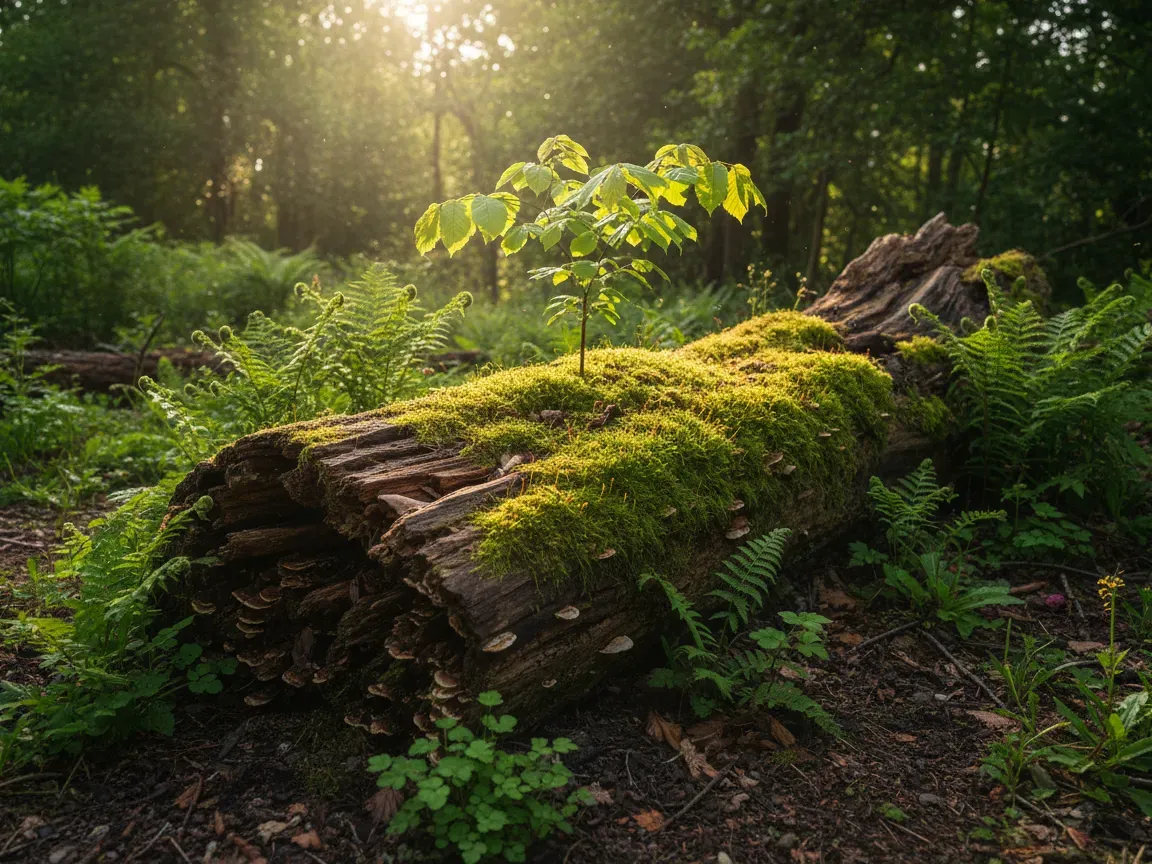
- Leave fully grounded trunks that lie flat in the interior woods, as they act as natural erosion barriers along sloped ground.
Rushing to clear cut removes the natural seed bank and eliminates shade, turning a cool forest floor into a baked, weed-friendly patch of dirt. Giving the woods a few months to respond usually reveals that far more trees survived than initially appeared.
Turning Debris into Habitat with On-Site Wood Composting and Hugelkultur
Hauling brush piles to the local landfill or burning large slash piles wastes valuable carbon and nutrients that your forest soil desperately needs. Instead of exporting that organic matter, repurpose storm debris directly on site to build soil vitality.
One effective strategy is hugelkultur, a traditional method of building raised garden or nursery mounds over decomposing logs:
- Dig shallow trenches along the natural contours of sloped land to catch runoff.
- Lay heavy, storm-felled hardwood logs at the bottom of the trench as a moisture-retaining sponge.
- Pile smaller branches, twigs, and inverted sod over the logs to fill the gaps.
- Cap the mound with a layer of compost, leaf litter, and topsoil, then plant it with native understory species.
As the buried wood rots slowly over a decade, it acts as an underground reservoir that holds groundwater during summer droughts. Smaller limbs and brush that do not fit into mounds can be arranged into loose windrows across slopes, catching drifting leaves and preventing heavy rain from washing topsoil into nearby creeks.
How Can Standing Deadwood Benefit Post-Disaster Wildlife Recovery?
In traditional forestry, broken standing trees are often viewed as waste or eyesores. In wildlife biology, these standing dead trees, known as snags, are among the most valuable habitat components in the entire ecosystem. Storms create natural snags instantly, providing essential resources for animals displaced by canopy loss.
Woodpeckers, nuthatches, and chickadees depend on decaying wood to forage for wood-boring insects. These primary excavators carve out nesting cavities that are later used by flying squirrels, screech owls, bluebirds, and native solitary bees. Without standing deadwood, cavity-nesting species vanish from the recovering area.
If a snapped tree does not pose a physical hazard to trails, power lines, or buildings, consider leaving a ten- to twenty-foot trunk standing. You can ask an arborist to safely top the tree rather than fell it entirely. Over the next decade, that single decaying pillar will support hundreds of species of fungi, lichens, invertebrates, and birds, speeding up the biological recovery of your woods.
Choosing Resilient Native Species to Rebuild a Weather-Proof Canopy
A storm-damaged canopy opens up sunlight for the forest floor, offering a prime opportunity to diversify your tree cover. Many damaged stands were monocultures or even-aged stands that lacked the structural diversity needed to withstand high winds and ice loads. Rebuilding requires selecting native species that naturally adapt to shifting weather patterns.
When sourcing seedlings from state or local conservation nurseries, keep several structural traits in mind:
- Deep taproot species like white oak, bur oak, and various native hickories anchor deep into the subsoil and resist severe wind-throw far better than shallow-rooted trees.
- Flexible hardwoods such as river birch, black gum, and certain native maples bend under heavy ice loads without catastrophic trunk snapping.
- Diverse understory trees like serviceberry, redbud, and American hornbeam create a multi-layered canopy that buffers ground-level gusts and shelters soil.
- Varied age classes and irregular planting layouts mimic old-growth stands and prevent wind from sweeping cleanly through wide gaps.
Avoid planting fast-growing, brittle non-natives or single-species conifer patches that snap easily during unseasonal winter storms. Diversity is the best natural insurance policy for forest health.
Local Conservation Steps to Take While Waiting on Federal Relief
Navigating federal backlogs does not mean you are entirely on your own. Most rural regions host an array of local, non-emergency resources that can assist your self-reliant recovery efforts right away.
Connect with your county soil and water conservation district or local university agricultural extension office. These agencies often offer free on-site consultations, low-cost native seedling sales every spring, and mechanical tree-planter rentals for nominal fees. They can also connect you with community volunteer groups or master naturalists who help with invasive weed removal.
Documenting all self-funded work remains important. Take clear photographs of damaged zones before you touch them, track your personal labor hours, and keep every receipt for equipment rental or bare-root tree orders. If federal appropriations eventually loosen up, or if supplementary state disaster funds open, accurate paper trails often allow retroactive reimbursement for qualified stewardship tasks.
Building Forest Resilience Through Self-Reliant Action
Relying solely on delayed bureaucratic relief programs leaves damaged land exposed to erosion, pest outbreaks, and invasive overgrowth. By stepping in with hands-on, eco-conscious stewardship, you take control of your woodland’s future while working alongside natural ecological processes.
Every downed trunk anchored into a swale, every standing snag spared from the chainsaw, and every native sapling planted helps turn sudden disruption into lasting structural health. Storms are an inevitable part of the landscape cycle, but proactive, low-impact management ensures your forest returns stronger, more diverse, and better equipped for whatever weather lies ahead.